Monday, 12 March 2012
Public-Private
The afternoon session was divided up into a discussion of public - private affects of social media. The first speakers Nusta Nina talked about different CSMP user catgorisations and practices including the digital narcissism or vulnerable narcissism of 'The Nexters' (young people). I.e young people do not at this moment in their lives, care about privacy. The idea of a 'distributed identity' and how concepts of OpenID had still to take hold. Another point that I have mentioned in my research is the idea of terms & conditions creep. In that the terms and conditions you sign up to in 2005 change over the years, and generally you are not required to resign up or are given the option to leave (with all your data which related to your initial sign up), which ties in to a call for a greater media literacy amongst users. Arnold Roosendaal made the point that the 'Like' button works in a passive manner, and does not need to be clicked to record data (something that is now illegal in parts of Germany). He then went on to talk about ID construction, in particular mentioned the Gary Walker experiment which exposes the ease of ID forgery, and also the reliance that third party platforms, such as Spotify have on Facebook Connect, which during a recent server collapse meant that Spotify was down as well.


Missing Projects (UnlikeUs)
Some of the artist showcase were missing from the afternoon session. Tobias Leingruber's project did (until it was taken down as part of a cease and desist order from Facebook) engages with the idea of global identity management, whereby he issues real world ID cards which approximate those the FB offers using Facebook Connect, and devalues those produced by countries in the form of passports. Other projects can be viewed here and a discussion here.
What is of note is that the critique of Facebook as global identity manager is happening from inside Facebook, not as a result of an exodus, and this marks it out as different from the norm.
Artists Use, misuse or dissertion of social media

The afternoon session featured a collection of artists who in some manner had engage in social media through their practice. Walter Langelaar spoke about his group moddr who made the popular Web Suicide Machine artwork (which was actually preceded by a burger King advert). The next piece they are working on is the GIve Me My Data plugin that allows users to download all their data from the walled garden of platforms such as Facebook. Speaking afterwards to Walter we talked about his exodus from CSMP commercial social media platforms, and the fact he will not be returning, as well as the difficulty of working with communities with FLOSS, as a way of staging an alternative rendering of social media practice.
 |
| Dimitry Kleiner - UnLikeUs 2012 |
Other practitioners of note were Dmytri Kleiner who presented various projects made with in association with telekommunisten. Of particular note was the project thimbl a micro-blogging application that relies on the finger protocol , which was developed in the 1970's, and is included in all current server releases. A case of certain communitarian principles being in place early on and then being included, but not used as these principles were realigned. As Kleiner stated ' capitalism will never fund P2P networks as there is not place for the cash booths'.
Reification 2.0
In the second part of the morning session of the UnlikeUs conference Dylan Wittkower gave is presentation. His research focuses on the sociological appraisal of the social graph invoked by social media. He noted several phenomena ranging from the marketing of products to friends within social media (in order to win a prize) to the real focus of his talk, the methods that are used to construct and expose identity see:
"Wittkower also discusses four main strategies of identity construction on the spectrum of proactive, reactive, unitary and divergent. An untidy identity – found at the corner of proactive and divergent – relies on the actions of others, such as tagging, in the making of an individual’s online preseence. A spectacular identity – proactive and unitary- draws on Guy Debord’s notion of the spectacle. It is an experience of the Self as a thing, protecting itself outwardly and ridden with interpassivity and simulacrazation. A distributed identity – reactive and divergent – is constructed on the walls of others, on group pages or on fan pages. A lurking identity – reactive and unitary – does just that: lurks aroud the Web and takes no further action. Wittkower believes that some of these strategies will resolve into more meaningful forms of interaction. Whereas friendertainment might lead to teleboredom, asking the network may very likely lead to fruitful conversation."
"Wittkower also discusses four main strategies of identity construction on the spectrum of proactive, reactive, unitary and divergent. An untidy identity – found at the corner of proactive and divergent – relies on the actions of others, such as tagging, in the making of an individual’s online preseence. A spectacular identity – proactive and unitary- draws on Guy Debord’s notion of the spectacle. It is an experience of the Self as a thing, protecting itself outwardly and ridden with interpassivity and simulacrazation. A distributed identity – reactive and divergent – is constructed on the walls of others, on group pages or on fan pages. A lurking identity – reactive and unitary – does just that: lurks aroud the Web and takes no further action. Wittkower believes that some of these strategies will resolve into more meaningful forms of interaction. Whereas friendertainment might lead to teleboredom, asking the network may very likely lead to fruitful conversation."
Bits of Freedom
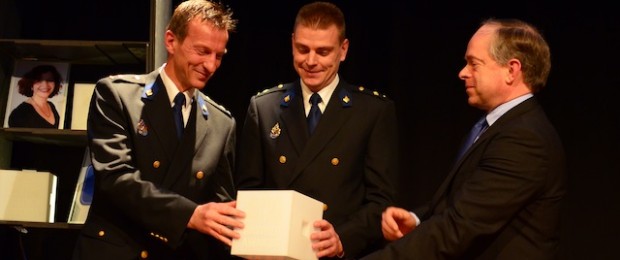 |
| The police picking up their Big Brother Award 2011 |
On arriving at the UnlikeUs conference we popped into the last session of the Thursday, bits of freedom were talking about various projects - particularly where they had influenced legal precedent in respect to Facebook and privacy laws in Europe. All of this points towards the campaign Europe versus Facebook, where the incompatibilities between FB and European law are played out, for example in requesting your data from FB, see here. Bits of Freedom also host the big brother awards which celebrate those agencies and players most culpable in abuses of freedom and privacy.
Friday, 9 March 2012
unlikeus conference amsterdam day one [tmorning]
Todays conference was really good, and the venue was the upstairs from the subterrarian pit where yesterdays presentations took place. after a great breakfast Gert lovink gave a really good intro calling for a form of web sociology.

Jodi Dean (usa) spoke very interestingly about the constitution of the social in social media critique. she gave three definition of the contention that society does not exist. Her first the neo-liberal version as espoused by thatcher, the second a rendering provided by ANT/Object theory and third the version provided by Lacau & Mouffe. Her point was that social media is a mirror each of these contentions and the motif of the network, as the representative of the social, is a simulacra of these relationships. her claim was that if society did exist then there would not be a need for social media platforms.
She consistently problematicised social media critique for always talking of dispersion, privacy and identity concerns (a position she stated it shared with the neo liberal dismissing of society) what she asked would their version of social media look like ? was not more a fact that these critics had - from a psychoanalytic viewpoint - had issues with trust, that they did not trust these vast conglomerations.
So for dean it was not the issues of the vast numbers of users, the bottleneck, but rather that these were concentrated into the hands of one person/company. And that dispersion is more likely to produce the 'one' of neo liberal politics, as she said, 'no long tail without the strong one' - and there is in fact an underlying desire that people want to be part of a whole. for instance in the claim that twitter enabled the recent arab spring protests was dismissed as confusing the form, which allows for collectivity, and focusing on the content. FB then is the private ownership of this form of collectivity and that is the problem with FB.

Jodi Dean (usa) spoke very interestingly about the constitution of the social in social media critique. she gave three definition of the contention that society does not exist. Her first the neo-liberal version as espoused by thatcher, the second a rendering provided by ANT/Object theory and third the version provided by Lacau & Mouffe. Her point was that social media is a mirror each of these contentions and the motif of the network, as the representative of the social, is a simulacra of these relationships. her claim was that if society did exist then there would not be a need for social media platforms.
She consistently problematicised social media critique for always talking of dispersion, privacy and identity concerns (a position she stated it shared with the neo liberal dismissing of society) what she asked would their version of social media look like ? was not more a fact that these critics had - from a psychoanalytic viewpoint - had issues with trust, that they did not trust these vast conglomerations.
So for dean it was not the issues of the vast numbers of users, the bottleneck, but rather that these were concentrated into the hands of one person/company. And that dispersion is more likely to produce the 'one' of neo liberal politics, as she said, 'no long tail without the strong one' - and there is in fact an underlying desire that people want to be part of a whole. for instance in the claim that twitter enabled the recent arab spring protests was dismissed as confusing the form, which allows for collectivity, and focusing on the content. FB then is the private ownership of this form of collectivity and that is the problem with FB.
Tuesday, 6 March 2012
Topology: Spaces of Transformation Topology: Secrets of Space Topology: Embodying Transformation 5 November 2011–16 June 2012 Tate Modern, Starr Auditorium Bankside London SE1 9TG
| I went to this on saturday @ Tate Modern: Artist Olafur Eliasson in conversation with Bruno Latour and Peter Weibel. Chaired by Catherine Malabou. It was good, and in part quite funny. Latour and Weibel completely disagreed about the construction of space, for Latour space is inscribed, which he related to art history, Weibel made use of graph theory, after Weibel had explained his position Latour said 'I disagree with everything you have said'. Somewhere in the middle was Eliasson, who has worked and made work with both Weibel and Latour. The discussion was pretty stunted as a result of their intransigence, although Eliasson acted as a good glue between the two, the chair was pretty poor. | ||
Subscribe to:
Posts (Atom)